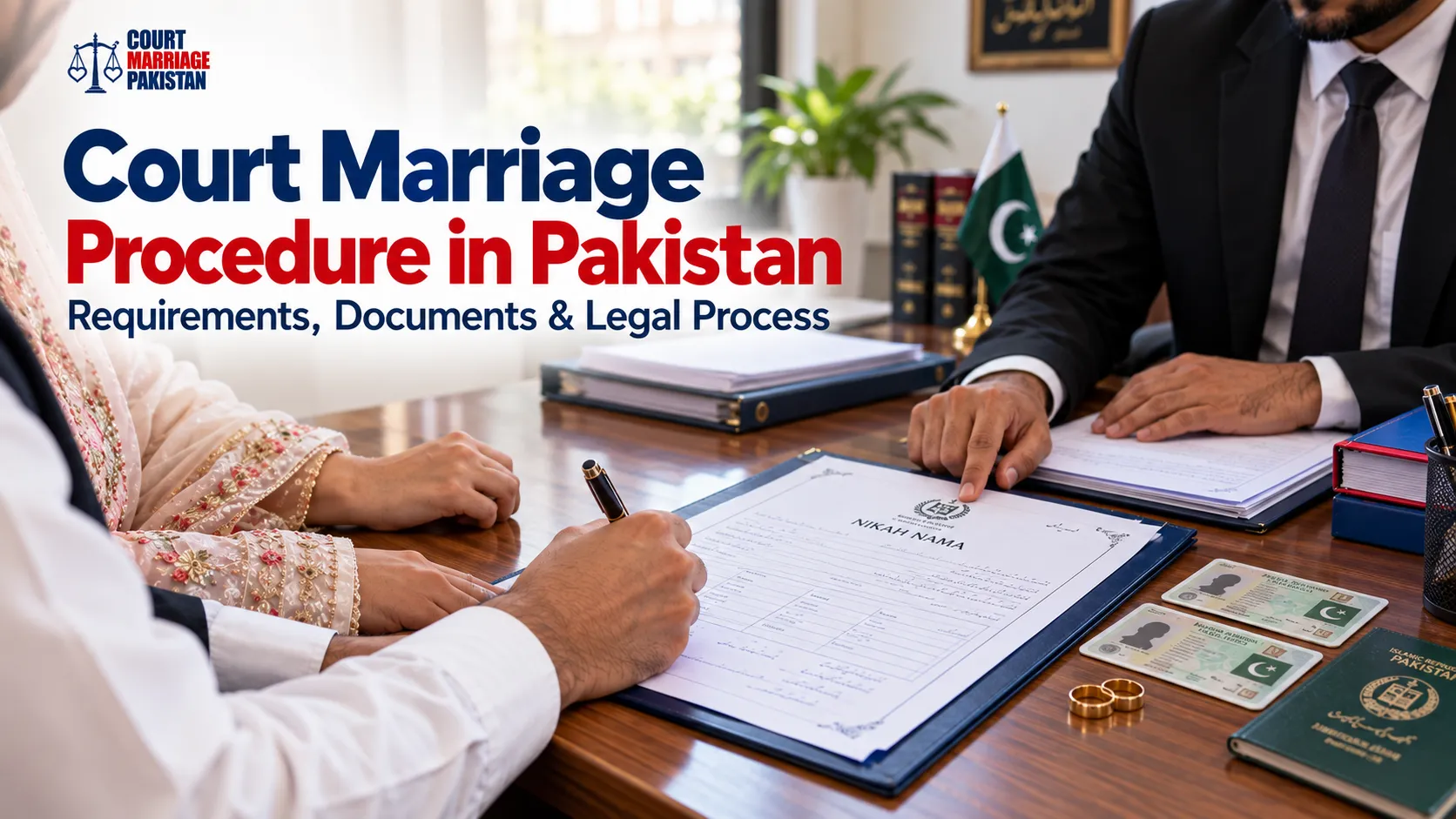
The court marriage procedure in Pakistan becomes much easier to understand when it is divided into three parts: checking whether both people can legally marry, completing the Nikah correctly, and registering the marriage with the relevant authority.
Published Updated By Court Marriage Pakistan legal team
For Muslim marriages, the Muslim Family Laws Ordinance, 1961 is one of the main laws governing marriage registration. Section 5 states that every marriage solemnized under Muslim law must be registered. It also provides for Union Councils to license Nikah Registrars for this purpose.
The term “court marriage” can sometimes cause confusion. In Pakistan, it does not normally mean that a judge must perform your marriage inside a courtroom. People commonly use the term for a marriage entered into by two consenting people through Nikah, supported by the required documents and followed by proper marriage registration.
This guide explains the court marriage process in Pakistan, including the legal requirements, documents, consent, witnesses, Nikah Nama, registration and Marriage Registration Certificate.
For most Muslim couples, the legal procedure for court marriage in Pakistan can be understood through these basic stages:
The exact paperwork and local registration procedure can differ depending on the province, city, Union Council or other competent local authority.
“Court marriage” is a commonly used phrase in Pakistan, but the Muslim Family Laws Ordinance does not create a separate type of Muslim marriage called a “court marriage.”
The important legal steps are the Nikah and registration of the marriage.
A couple may choose this route when they want to marry through their own free choice, prefer a private marriage, need legal documentation, or want professional help with the Nikah and registration process.
A court building is not what makes the marriage valid.
For Muslim marriages, the important issues include legal capacity, free consent, the Nikah itself, properly completing the Nikah Nama and registering the marriage as required by law.
Section 5 of the Muslim Family Laws Ordinance also makes an important distinction. A marriage does not necessarily have to be solemnized by the licensed Nikah Registrar himself. If someone else solemnizes the marriage, the law provides that the marriage should be reported to the Nikah Registrar for registration.
This means a Nikah Khawan and a Nikah Registrar may perform related roles, but they are not automatically the same thing in every case.
If you are looking for help with the complete marriage rather than general information, see our Court Marriage in Pakistan service.
The question is that Is Court Marriage Allowed in Islam? Yes. Two people who meet the applicable legal requirements can enter into a lawful marriage in Pakistan.
For Muslim marriages, the Muslim Family Laws Ordinance, 1961 provides the framework for marriage registration. Section 5 requires marriages solemnized under Muslim law to be registered and provides for licensed Nikah Registrars.
The West Pakistan Rules under the Muslim Family Laws Ordinance, 1961 also prescribe Form II, commonly known as the Nikah Nama. The form records important information including the bride and groom, their ages, marital status, witnesses, dower and other marriage details.
A lawful marriage therefore involves more than simply signing a private paper. The couple should make sure that the Nikah is properly completed and the registration process is followed.
Free consent is equally important. Section 498-B of the Pakistan Penal Code prohibits forcing a woman into marriage and provides criminal punishment for coercion.
The legal age for court marriage in Pakistan must be checked according to the province or territory where the marriage is taking place.
It is important not to rely on old articles that give one age rule for the entire country. Child-marriage laws have changed significantly in recent years.
For the major cities currently covered by Court Marriage Pakistan:
| Location | Current minimum age |
|---|---|
| Karachi / Sindh | 18 for both parties |
| Lahore / Punjab | 18 for both parties |
| Rawalpindi / Punjab | 18 for both parties |
| Islamabad Capital Territory | 18 for both parties |
In Sindh, the Sindh Child Marriages Restraint Act, 2013 defines a child as a male or female under 18 years of age.
Punjab changed its law in 2026. The Punjab Child Marriage Restraint Act, 2026, which came into force on 11 May 2026, defines a child as a male or female under 18 years of age.
Islamabad follows the Islamabad Capital Territory Child Marriage Restraint Act, 2025, which also defines a child as a person, male or female, below 18.
The exact court marriage requirements in Pakistan depend on the couple's circumstances and jurisdiction, but several issues normally need to be checked before the Nikah.
The first step is confirming that both parties meet the legal requirements applicable to them.
This normally includes checking:
For someone who has previously been married, it is particularly important not to assume that an informal separation means the previous marriage has legally ended. Relevant divorce, talaq, khula or death documentation should be checked before another marriage is completed.
A marriage should be based on genuine and voluntary consent.
Neither party should be forced, threatened or pressured into marrying.
For Muslim adults, the issue of parental permission is also commonly misunderstood. Pakistani superior-court jurisprudence has recognized that a legally competent adult Muslim woman can contract a marriage of her own free will without making her wali's consent a condition of the marriage's validity. The leading Supreme Court decision is commonly reported as Hafiz Abdul Waheed v. Mrs. Asma Jehangir, PLD 2004 SC 219.
That principle applies to an adult who otherwise meets the applicable legal requirements. It should never be used to avoid child-marriage laws.
Identity documents are an important part of the court marriage process. For Pakistani citizens, this will commonly mean a valid CNIC. An overseas Pakistani may use a NICOP or passport where applicable, while foreign-national cases can involve additional identity, immigration and authentication requirements.
The exact document checklist should be confirmed before the Nikah rather than after documents have already been signed.
The documents required for court marriage in Pakistan depend on the couple's situation and the local registration authority. A typical checklist may include:
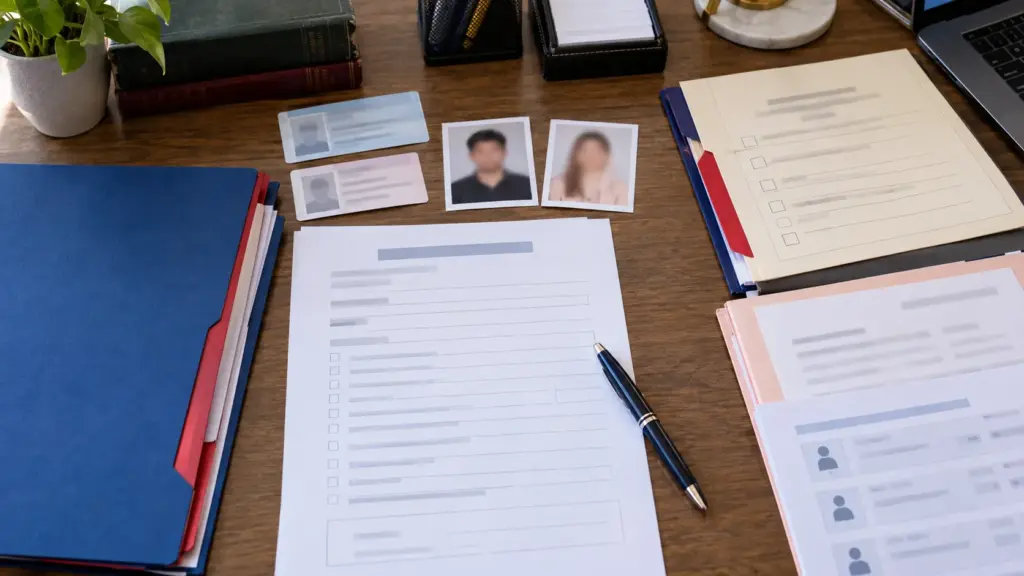
| Document | Why it may be needed |
|---|---|
| CNICs of bride and groom | To confirm identity and age |
| NICOP or passport | Relevant for overseas Pakistanis or some foreign-national cases |
| Witness identity documents | To record and verify witnesses |
| Recent photographs | Requested by some offices or local processes |
| Divorce or khula documents | Where either party was previously divorced |
| Death certificate of previous spouse | Where either party is widowed |
| Additional proof of age | Where normal identity documents do not sufficiently establish age |
| Free-will or consent affidavit | Used in some cases or local practices, particularly where written evidence of voluntary consent is useful |
Not every document in this table is a universal statutory requirement for every marriage in Pakistan.
For example, a free-will affidavit can be useful in cases where voluntary consent needs to be clearly documented, but Section 5 of the Muslim Family Laws Ordinance and the standard Form II Nikah Nama do not themselves make a separate free-will affidavit a universal condition for every Muslim marriage throughout Pakistan.
Local requirements matter. Sindh provides a useful example. Rules made under the Sindh child-marriage framework require the person solemnizing the marriage to satisfy himself that both parties are at least 18 and require attested copies of valid CNICs to be attached to the Nikah Nama. The rules also deal with age verification where a CNIC is unavailable.
For that reason, it is better to verify the exact checklist for your city rather than downloading a generic “Pakistan court marriage documents” list and assuming it applies everywhere.
The following explains how to do court marriage in Pakistan in practical terms.
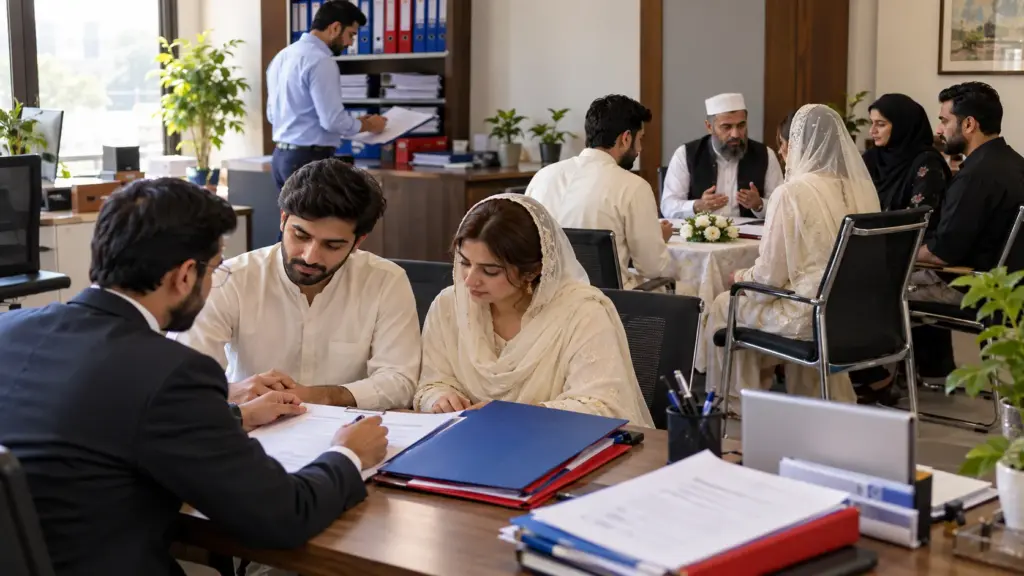
Before preparing affidavits, booking a Nikah Khawan or signing any document, confirm that both people are legally able to marry. Age is the first issue to check. As explained above, Karachi, Lahore, Rawalpindi and Islamabad currently require both parties to be at least 18 under their respective child-marriage laws.
Next, check marital status. If either person was previously married, the documents showing how that marriage ended should be reviewed. Depending on the circumstances, this may include a divorce certificate, khula decree or death certificate of a previous spouse.
Do not hide or incorrectly state a previous marriage on the Nikah Nama. Form II specifically asks about the bride's marital status and contains other information relevant to the marriage contract.
The next part of the court marriage process in Pakistan is document verification. Names, CNIC numbers, ages and other personal information should be checked carefully before being entered on marriage documents.
Even a simple spelling difference between the CNIC and Nikah Nama can create avoidable problems later when the marriage is registered or when the couple needs the record for another official purpose.
Overseas Pakistani and foreign-national cases often require additional review because passports, NICOPs, powers of attorney or foreign documents may be involved.
Both parties should clearly confirm that they are marrying voluntarily. This is more than a formality. Forced marriage is prohibited under Pakistani criminal law. Section 498-B of the Pakistan Penal Code specifically criminalizes coercing or compelling a woman into marriage.
Some court-marriage processes also use a written free-will affidavit or free-consent affidavit. This can provide additional written evidence that the person is marrying voluntarily. However, whether a particular affidavit is required should be confirmed according to the circumstances and local procedure.
Once eligibility and documents have been checked, the Nikah can be arranged. A Nikah Khawan may conduct the Nikah ceremony, while registration must be handled through the competent Nikah Registrar and relevant authority.
This distinction matters. Section 5(3) of the Muslim Family Laws Ordinance specifically contemplates a marriage being solemnized by a person other than the Nikah Registrar and requires such a marriage to be reported to the registrar for registration.
During the Nikah, the parties formally enter into the marriage through their consent to the marriage contract. The Nikah also records Haq Mehr, also called Mahr or dower. The amount and terms of Haq Mehr should be discussed clearly rather than treated as an unimportant blank on the form.
Witness details also form part of the official Nikah Nama. Form II prescribed under the Muslim Family Laws rules contains fields for two witnesses to the marriage, together with their fathers' names and residences.
The Nikah Nama is one of the most important documents in the entire process. It should not be treated as a paper that everyone simply signs without reading. The standard Form II contains information about matters such as:
Couples should make sure names, identity details and agreed terms are entered correctly before signing. This is particularly important because correcting an error later can require additional work with the relevant registration authority.
Completing the Nikah is not the end of the administrative process. Section 5 of the Muslim Family Laws Ordinance states that every marriage solemnized under Muslim law shall be registered according to the Ordinance. The signed Nikah Nama therefore needs to move through the appropriate registration process.
The exact authority can depend on the area. In many cases this involves the relevant Union Council, while other competent local bodies may handle civil registration in particular jurisdictions. Couples should identify the correct authority instead of submitting documents wherever it seems most convenient.
After registration, couples may also need a computerized Marriage Registration Certificate, commonly called an MRC. People often search for this document as a “NADRA marriage certificate,” but that phrase can create the wrong impression.
NADRA explains that Pakistan's provincial Civil Registration and Management System (CRMS) is deployed across Union Councils and supports registration of vital events including marriages. In practical terms, the MRC is obtained through the competent local registration authority using the CRMS infrastructure.
After the Nikah has been performed and the Nikah Nama signed, the next important task is making sure the marriage is properly registered. This distinction is important:
These terms are often used as though they all mean the same thing, but they do not. The Muslim Family Laws Ordinance places a clear legal requirement on registration of Muslim marriages. Couples should therefore not stop after receiving a signed paper from the Nikah ceremony — they should confirm that the marriage has moved through the proper registration channel.
For a legally competent adult Muslim woman who meets the applicable marriage-age requirement, Pakistani case law has recognized her ability to contract marriage of her own choice without making the consent of her wali or parents a condition of validity.
The Supreme Court's decision reported as Hafiz Abdul Waheed v. Mrs. Asma Jehangir, PLD 2004 SC 219 considered this issue and recognized the established position concerning a sui juris Muslim woman's capacity to marry of her own accord.
This does not mean every family-dispute case is simple. Where there are allegations of abduction, threats, coercion, disputed age, identity problems or serious safety concerns, professional legal advice can be important.
A lawyer is not listed in Section 5 of the Muslim Family Laws Ordinance or Form II as a basic condition for the validity of every Muslim marriage. Many straightforward marriages can therefore be completed without a court case.
However, legal assistance can be useful where the situation involves:
A lawyer and a Nikah Khawan also perform different roles. The Nikah Khawan deals with solemnizing the Nikah. A lawyer provides legal advice or representation where it is needed. The Nikah Registrar handles the statutory registration role for the relevant jurisdiction.
There is no single legally guaranteed timeline for every court marriage. Where both parties are legally eligible and all documents are complete, the Nikah itself may be completed on the same day.
That does not necessarily mean every later administrative step will also be completed that day.
Registration and issuance of the MRC can take additional time depending on:
For this reason, phrases such as “same-day court marriage in Pakistan” should normally be understood as referring to the ability to complete the Nikah when everything is ready, not as a guarantee that every government-issued document will also be available within a few hours.
Couples with a visa, travel or other deadline should plan around the complete registration process rather than only the ceremony.
There is no single nationwide court marriage fee in Pakistan that applies to every couple. The total court marriage cost can depend on the services required.
For example, a couple may pay separately for professional assistance, document preparation, Nikah arrangements, registration charges, certificates, attestations or special handling of an overseas or foreign-national case. Costs can also differ between cities and registration authorities.
The safest approach is to request an itemized quote showing which charges relate to professional services and which are government or registration charges.
A previous marriage does not automatically prevent someone from marrying again, but the earlier marriage must have legally ended. A divorced person should have the relevant evidence showing termination of the previous marriage — talaq documentation, a divorce certificate, khula decree or another legally relevant record. A widow or widower may need the death certificate of the previous spouse.
Do not treat this as a paperwork technicality. An unresolved prior marriage can create serious legal and registration problems. The effective legal date of a divorce can also matter, so individual cases should be checked properly before a new Nikah.
Overseas Pakistani cases can involve additional documentation. Depending on how the marriage is being arranged, documents may include a NICOP, passport, properly executed authority documents and other authenticated paperwork. If one party cannot attend physically, the couple should confirm the correct legal method before proceeding. Do not assume that joining a video call by itself completes all legal requirements.
Court Marriage Pakistan has a separate Online Nikah service for couples and overseas Pakistanis who need guidance on remote participation, representation and subsequent registration.
A Pakistani marrying a foreign national can face extra document and verification requirements. A passport will normally be important, and additional proof relating to identity, marital status, nationality or foreign documents may be requested depending on the case. Foreign documents may also need authentication or attestation before they can be accepted for a local registration process.
Because requirements can vary considerably by nationality and circumstances, couples involving a foreign citizen should have their documents checked before scheduling the Nikah.
Most avoidable problems happen because documents or legal requirements were not checked before the Nikah. Common examples include using an expired or incorrect identity document, spelling a name differently from the CNIC, entering the wrong age, failing to disclose a previous marriage, missing divorce or death documentation, leaving important Nikah Nama fields incomplete, misunderstanding the applicable marriage-age law or submitting documents to the wrong local registration authority.
Another common mistake is believing that the Nikah ceremony and civil registration are exactly the same step. They are connected, but registration still has to be completed according to the Muslim Family Laws Ordinance.
Couples should also avoid assuming that every document promoted by a private service provider is automatically required by national law. Some documents, such as particular affidavits or photographs, can depend on the jurisdiction, local administrative practice or circumstances of the case.
Before proceeding, check the following:
Yes. Two people who meet the applicable legal requirements can marry lawfully in Pakistan. For Muslim marriages, Section 5 of the Muslim Family Laws Ordinance, 1961 requires the marriage to be registered, and the Nikah Nama (Form II) records its details.
No. “Court marriage” is a common phrase, not a separate type of Muslim marriage. What makes the marriage valid is legal capacity, free consent, a properly performed Nikah, a correctly completed Nikah Nama and registration — not a court building.
Typically the CNICs of the bride and groom (or a NICOP or passport for overseas cases), witness identity documents, recent photographs where requested, and divorce, khula or death-certificate documents where either party was married before. Confirm the exact checklist with your local registration authority.
For Karachi (Sindh), Lahore and Rawalpindi (Punjab) and Islamabad Capital Territory, the current minimum is 18 for both parties. Provincial laws have changed recently, so always check the law in force where the marriage will take place.
Pakistani case law, including Hafiz Abdul Waheed v. Mrs. Asma Jehangir (PLD 2004 SC 219), recognizes that a legally competent adult Muslim woman can contract her own marriage. That principle applies only to adults and can never be used to bypass child-marriage laws.
The prescribed Nikah Nama (Form II) contains fields for two witnesses to the marriage. Their identity details are recorded on the form.
Not under Section 5 of the Muslim Family Laws Ordinance or the standard Form II. A free-will affidavit can be useful where voluntary consent should be documented, and some local practices ask for one, so confirm locally.
A lawyer is not a basic condition for the validity of a Muslim marriage. Legal help is valuable where there is disputed age, family opposition, threats, an earlier marriage, overseas or foreign documents, or an unusual registration problem.
Where both parties are eligible and every document is complete, the Nikah itself may be completed on the same day. Registration and the Marriage Registration Certificate can take longer depending on the local authority and verification.
The Nikah Nama is the prescribed marriage-contract form signed at the Nikah. The Marriage Registration Certificate (MRC) is the computerized civil-registration record obtained afterwards from the competent local authority through CRMS.
Not in the way the phrase “NADRA marriage certificate” suggests. NADRA provides the CRMS system used by Union Councils; the MRC is obtained through the competent local authority that registers the marriage.
The completed Nikah Nama has to go through the proper registration process with the competent Nikah Registrar and local authority. After registration, the couple can obtain the Marriage Registration Certificate where required.
The court marriage procedure in Pakistan is not simply about signing a Nikah Nama or visiting a court. A properly handled case begins with legal eligibility and free consent, moves through the Nikah and accurate completion of the Nikah Nama, and ends with proper registration through the competent authority.
The most important step is to verify everything before the Nikah: age, identity, marital status, documents, consent and the correct registration jurisdiction.

Court Marriage Pakistan provides assistance with court marriage, document review, Nikah arrangements and marriage-registration support. Dedicated services are also available for Online Nikah and Nikah Khawan services.
For local guidance, you can also visit our dedicated city pages:
If your situation involves a previous marriage, overseas documents, a foreign national, family opposition or another unusual issue, get case-specific guidance before proceeding.