Yes, court marriage can be allowed in Islam. A marriage does not become haram (forbidden) simply because a couple chooses a court-related legal process instead of a traditional wedding ceremony. What matters is whether the marriage meets the Islamic requirements of Nikah.
Published Updated By Court Marriage Pakistan legal team
Yes, court marriage can be allowed in Islam. A marriage does not become haram (forbidden) simply because a couple chooses a court-related legal process instead of a traditional wedding ceremony. What matters is whether the marriage meets the Islamic requirements of Nikah.
These requirements include genuine consent, a valid marriage agreement, and compliance with the rules of the applicable Islamic school of thought. Scholars have different views on certain conditions, especially whether a woman needs the permission of a marriage guardian (wali).
In Pakistan, there is another important distinction: a marriage may need to satisfy both Islamic religious requirements and Pakistani legal requirements.
This guide explains court marriage in Islam, whether it is halal or haram, what makes a Nikah valid, and how Sunni and Shia views differ.
In Pakistan, court marriage usually refers to a marriage arranged through a legal process, often with assistance from a lawyer and a registered Nikah Khawan.
It is commonly chosen by couples who want to marry with their own consent, arrange proper documentation, or complete the process without holding a large wedding ceremony.
However, court marriage is not a separate type of Islamic marriage.
Islam recognizes Nikah as the marriage contract. A court building, lawyer's office, or marriage registrar's office does not automatically make a Nikah valid or invalid.
For example, if two eligible adults agree to marry, complete a Nikah that meets the requirements of their Islamic school, and follow the applicable Pakistani registration rules, choosing a legal office instead of a wedding hall does not itself make their marriage religiously forbidden.
On the other hand, simply signing a legal document does not necessarily fulfill every religious requirement.
The main differences are usually how the marriage is arranged and celebrated, not the basic purpose of the marriage.
| Court marriage in Pakistan | Traditional Nikah ceremony |
|---|---|
| Usually arranged through legal or professional assistance | Often arranged with family participation |
| May take place in a legal office or another suitable location | Commonly takes place at home, a mosque, or a wedding venue |
| Usually emphasizes legal paperwork and registration | May include religious, family, and cultural ceremonies |
| Must satisfy applicable Islamic requirements to be religiously valid | Must also satisfy applicable Islamic requirements |
| Must follow applicable Pakistani marriage laws | Must also follow applicable Pakistani marriage laws |
A large wedding, expensive celebration, or wedding hall is not necessary for a valid Islamic marriage.
The essential concern is the Nikah itself.
Court marriage is not automatically haram in Islam. It can be religiously permissible when the marriage meets the applicable Islamic conditions and does not involve prohibited circumstances.
The words halal and haram describe what is permitted or prohibited under Islamic law.
Calling a marriage a "court marriage" does not settle that question.
Instead, its permissibility depends on matters such as:
These conditions matter more than the location of the ceremony.
A court marriage can be Islamically permissible when the couple fulfills the relevant Nikah requirements.
Consider two adults who want to marry. Both freely agree, have no religious restriction preventing their marriage, and complete a valid Nikah in accordance with their school of Islamic law.
They may choose a simple ceremony rather than a large family gathering. The absence of an expensive wedding does not make their marriage haram.
Likewise, using a lawyer for paperwork or consulting a registered Nikah Khawan does not make the marriage religiously improper.
A marriage may raise religious concerns when an essential requirement is missing.
For example:
Whether a particular defect makes the marriage invalid, irregular, or otherwise prohibited depends on the relevant Islamic legal interpretation.
A couple should not assume that a marriage is valid simply because documents were signed, or invalid simply because their parents were not involved.
When there is uncertainty, the safest approach is to consult a qualified Islamic scholar familiar with the couple's circumstances and school of thought.
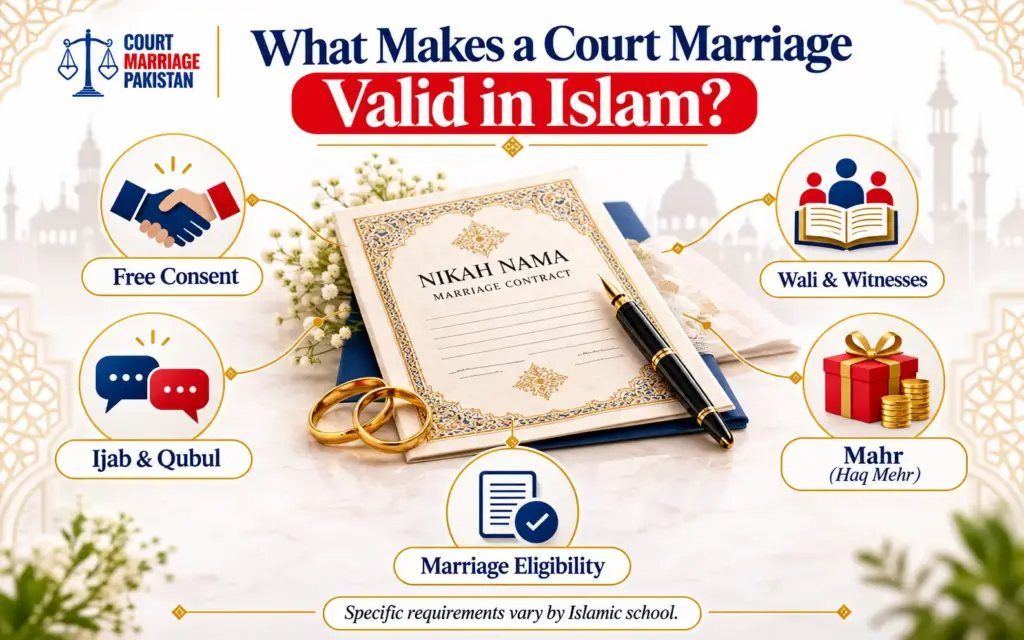
To understand whether court marriage is valid in Islam, it helps to understand the basic requirements of Nikah.
Islamic scholars agree on several important principles, although they differ on some details.
A valid marriage requires proper consent according to Islamic law.
Consent means that the individuals genuinely agree to the marriage.
A person should not be forced, threatened, or deceived into accepting a marriage.
The importance of consent appears in Sahih al-Bukhari 5136, where the Prophet Muhammad (peace be upon him) teaches that a woman must be consulted or asked for permission before marriage.
This is particularly relevant to couples considering court marriage because the decision to marry must not be based on coercion.
For example, if an adult woman clearly refuses a proposed marriage, her refusal should not be ignored.
The fact that families arrange or discuss a marriage does not remove the importance of the people getting married agreeing to it.
Nikah is a marriage contract, not simply a wedding celebration.
The contract involves an offer and acceptance, often called Ijab and Qubul.
In simple words, the marriage must be clearly offered and accepted in a way that fulfills the applicable religious requirements.
Depending on the Islamic school and circumstances, the contract may be conducted by the parties themselves or through properly authorized representatives.
A registered Nikah Khawan can help arrange the ceremony, but the religious validity depends on the contract and its requirements, not merely the person's professional title.
Witnesses are an important part of marriage under Sunni Islamic jurisprudence.
Sunni schools have requirements concerning marriage witnesses, although the exact rules and their application differ.
In many Pakistani Sunni Nikah ceremonies, two adult Muslim male witnesses are present. Under the Hanafi school, certain other witness combinations may also be accepted.
However, it would be inaccurate to claim that every Islamic school requires exactly the same witness arrangement.
For example, in Twelver Shia jurisprudence as explained by Ayatollah Ali al-Sistani, witnesses are not a condition for the religious validity of the marriage contract.
Couples should therefore follow the requirements of their own Islamic school and the separate documentation rules applicable in Pakistan.
A wali is a marriage guardian, commonly the bride's father or another person recognized under the relevant Islamic rules.
One of the most important disagreements among Islamic scholars concerns when a wali's participation or permission is required.
The Hanafi school generally allows a legally competent adult woman to conclude her own marriage contract, subject to important conditions.
Other major Sunni schools generally require a wali for a valid marriage.
Shia scholars also have specific guardianship requirements, which may differ depending on the woman's circumstances.
This is why the question "Is court marriage allowed without a wali?" cannot be answered accurately without considering the relevant school of Islamic law.
Mahr, sometimes called Haq Mehr in Pakistan, is a marital entitlement of the wife.
It is an obligation connected to the Islamic marriage contract, not a payment to her parents or to the Nikah Khawan.
The Quran discusses this obligation in Surah An-Nisa, verse 4:4.
Couples should properly understand and document the agreed Mahr.
However, the religious ruling on a marriage where the amount was not specified should not be confused with the obligation to provide Mahr. Islamic jurisprudence contains rules for such situations.
The marriage paperwork should accurately record the agreed terms and avoid leaving the couple uncertain about their rights.
The couple must also be legally and religiously eligible to marry one another.
Islamic law places restrictions on marriage between certain relatives and addresses other circumstances, including existing marriages and religious eligibility.
Relevant prohibited relationships are described in Surah An-Nisa, verse 4:23.
These issues should be checked when they are relevant to the couple's circumstances.
One of the most common concerns is whether Muslims can marry without their parents' approval.
The answer depends partly on the Islamic school of thought.
It is important to distinguish three different things:
These are related, but they are not identical.
According to the Hanafi school, a legally competent adult woman can generally enter into her own marriage contract without obtaining her wali's permission.
However, this position has qualifications, including rules relating to a suitable marriage match and Mahr. A marriage should not be assessed only by asking whether a father signed a document.
Egypt's official Dar al-Ifta explains this Hanafi position and distinguishes it from the views of other scholars.
This interpretation is especially relevant in Pakistan, where Hanafi jurisprudence is widely followed.
It does not mean that parental relationships, family concerns, and responsible advice have no importance.
When possible and safe, respectful family communication can prevent misunderstandings and future disputes.
The Shafi'i, Maliki, and Hanbali schools generally require a marriage guardian, although their detailed rules differ.
Their positions draw partly on Hadith concerning the necessity of a wali.
For example, Sunan Abi Dawud 2085 reports the importance of a guardian in marriage.
These scholars generally do not consider an adult woman's consent to remove every requirement concerning guardianship.
Where a guardian unreasonably prevents marriage, the relevant religious rules may provide a process involving another eligible guardian or a recognized authority.
Couples should seek qualified guidance rather than assume they may bypass these requirements without consequences.
Parents may object to a marriage for religious, financial, cultural, or personal reasons.
Not every objection has the same religious significance.
For example, concerns about an individual's character, existing marriage, or eligibility are different from objections based only on social status or family preferences.
Couples should understand both the religious position applicable to them and their rights under Pakistani law.
A disagreement with parents does not automatically make a marriage haram. Equally, being an adult does not automatically remove every guardianship requirement under every Islamic school.
Both Sunni and Shia Muslims recognize marriage as an important religious institution.
However, there are differences in Islamic jurisprudence concerning the marriage contract, guardianship, and witnesses.
Court marriage can be permissible under Sunni Islamic law if the Nikah meets the conditions of the particular Sunni school.
The main Sunni schools are Hanafi, Shafi'i, Maliki, and Hanbali.
All recognize the importance of a valid marriage contract, but their requirements are not identical.
The Hanafi school generally recognizes a legally competent adult woman's ability to conclude her own marriage contract under the school's conditions.
The other major Sunni schools generally require a wali.
Sunni schools also have detailed rules regarding witnesses and marriage contracts.
Therefore, a couple should not assume that following one school's interpretation automatically satisfies every other school's requirements.
Court marriage may also be permissible for Shia Muslims, provided the marriage meets the applicable Shia religious requirements.
In Twelver Shia jurisprudence, a properly concluded marriage contract is essential.
For example, Ayatollah Ali al-Sistani explains that the presence of witnesses or a cleric is not itself a condition for religious validity.
However, his rulings also address the permission of a father or paternal grandfather for a virgin woman's marriage, subject to certain conditions and exceptions.
These details show why it would be incorrect to describe all Shia marriage requirements as identical to Sunni requirements.
A Shia couple should follow the guidance of the religious authority they recognize and comply with applicable Pakistani law.
| Religious question | General Sunni position | Twelver Shia position |
|---|---|---|
| Is Nikah required? | Yes | Yes |
| Is free consent important? | Yes | Yes |
| Is a valid marriage contract required? | Yes | Yes |
| Is a wali required? | Depends on the Sunni school | Specific requirements and exceptions apply |
| Are witnesses required for religious validity? | Generally yes, with differing rules | Not required under al-Sistani's ruling |
| Does a legal office automatically validate the marriage? | No | No |
These are broad comparisons. Individual circumstances and scholarly interpretations may require more detailed guidance.
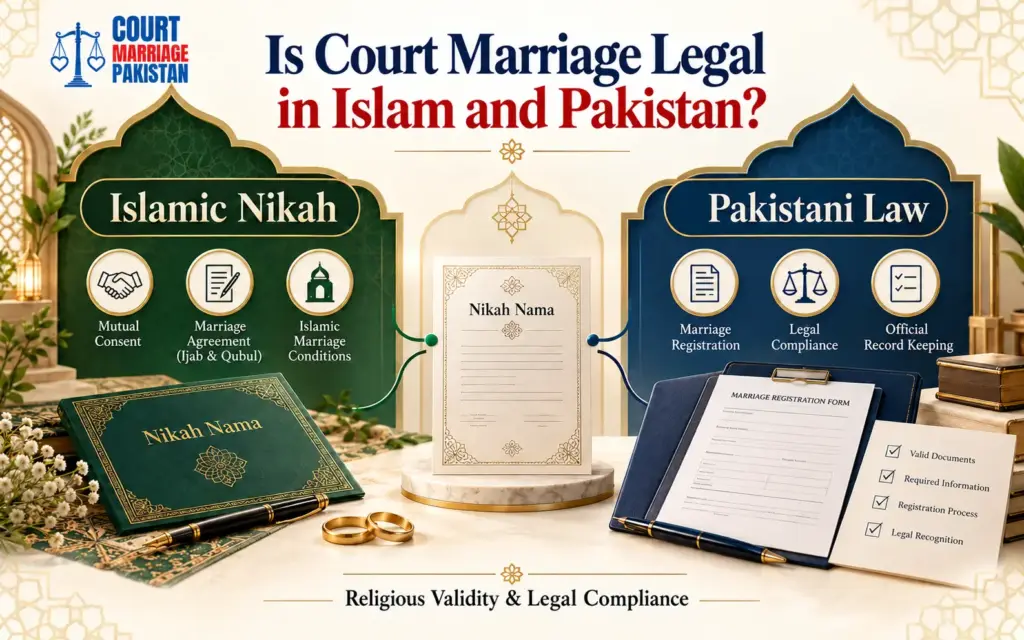
The phrase "is court marriage legal in Islam" brings together two different questions.
One concerns Islamic religious validity. The other concerns Pakistani civil law.
A marriage may need to satisfy both sets of requirements, but they serve different purposes.
Islamic law addresses matters such as the marriage contract, consent, guardianship, witnesses, and religious eligibility.
Pakistani civil law addresses matters such as marriage registration, legal marriage age, official records, and legal consequences.
Under Section 5 of the Muslim Family Laws Ordinance, 1961, Muslim marriages must be registered in accordance with the law.
Marriage registration provides an official record of the marriage and can be important for identity documents, family records, inheritance claims, and other legal matters.
However, failure to register should not automatically be described as making an otherwise valid Nikah religiously invalid. Registration compliance and religious validity are different questions.
The exact legal requirements can also depend on the province or territory, including applicable marriage-age legislation.
Pakistani courts have recognized the ability of legally competent adult Muslim women to marry of their own free will without parental consent.
An important decision is Hafiz Abdul Waheed v. Asma Jehangir and another, PLD 2004 Supreme Court 219.
This legal principle should not be confused with a claim that every marriage situation has the same requirements.
The couple must still satisfy applicable marriage-age laws, legal eligibility rules, registration requirements, and any other relevant law.
It is also important to understand that a civil court decision about legal capacity does not eliminate differences among Islamic schools concerning religious guardianship.
Not necessarily.
The phrase "court marriage" is commonly used in Pakistan for marriages arranged with legal assistance.
It does not mean that every marriage requires a judge to conduct the Nikah or issue a marriage order.
The marriage process and any required registration must follow the applicable laws and recognized procedures.
For a fuller explanation of the paperwork and legal process, read our guide.
Court marriage can be halal when the Nikah meets the requirements of the applicable Islamic school and does not involve prohibited circumstances. The location of the marriage alone does not determine whether it is halal or haram.
It depends on the Islamic school and the circumstances. Hanafi jurisprudence generally permits a legally competent adult woman to conclude her own marriage contract under certain conditions. Other major Sunni schools generally require a wali. Twelver Shia jurisprudence has its own guardianship rules.
The absence of parental approval does not automatically make every marriage invalid under all Islamic schools. However, guardianship requirements differ, and the circumstances must be assessed carefully. A qualified scholar can advise on the position relevant to the couple.
Yes, a marriage arranged through a court-related process can be permissible under Sunni Islam if the Nikah fulfills the relevant school's conditions. Sunni scholars differ on some requirements, especially the role of the wali.
The family's absence does not, by itself, establish that a marriage is haram. The important issues include whether the religious marriage contract is valid, whether consent is genuine, and whether the applicable guardianship and witness rules have been followed.
Not necessarily. Documents alone should not be assumed to satisfy every Islamic requirement. The couple must establish a valid marriage contract according to the relevant religious rules and fulfill Pakistani legal requirements.
جی ہاں، اسلام میں کورٹ میرج جائز ہو سکتی ہے، بشرطیکہ نکاح شرعی اصولوں کے مطابق ہو۔
یعنی لڑکا اور لڑکی کی رضامندی ہو، نکاح کا درست طریقہ اختیار کیا جائے، اور متعلقہ فقہی مسلک کی شرائط پوری ہوں۔ ولی اور گواہوں کے بارے میں مختلف فقہی مسالک کے احکام مختلف ہو سکتے ہیں۔
Simple: Court marriage can be permissible in Islam if the Nikah fulfills the applicable religious requirements. The rules concerning a wali and witnesses may differ among Islamic schools.
Court marriage is not forbidden in Islam simply because a couple chooses a legal office or a private ceremony instead of a traditional wedding.
What matters is whether the marriage meets the applicable Islamic requirements.
The key points are:
Hanafi, other Sunni, and Shia scholars differ on certain details. For this reason, couples with questions about religious validity should seek guidance from a qualified scholar familiar with their school of thought.
Court Marriage Pakistan provides assistance with court marriage arrangements, Nikah services, and marriage documentation in Pakistan.
If you want to understand the legal process, required documents, or registration options, our team can help explain the practical steps.